

GenAI-based Artistic Agency for Enhancing On-Site Exhibition
基于生成式人工智能的艺术代理
本项目旨在运用生成式人工智能,特别是低秩适应技术(Low-Rank Adaptation, LoRA),通过获得艺术家授权其作品数据,训练具有特定艺术家风格的智能艺术代理。我们通过将艺术代理与虚拟现实、无线射频识别(RFID)技术进一步结合,设计并开发适用于现场艺术展览的交互装置。 通过艺术展览现场的智能艺术代理,本项目旨在丰富观众的在地观展体验,进一步以艺术代理作为连接艺术家与观众的参与式共创媒介,探索数字创意产业心的AI-艺术家共赢范式。
This project aims to leverage generative artificial intelligence—particularly Low-Rank Adaptation (LoRA) techniques—to train intelligent art agents in the style of specific artists, using artwork data obtained with the artists’ authorization. By further integrating these art agents with virtual reality (VR) and radio-frequency identification (RFID) technologies, we design and develop interactive installations suitable for on-site art exhibitions. By deploying intelligent art agents in exhibition venues, this project seeks to enrich visitors’ situated viewing experience and to use these agents as a participatory co-creation medium connecting artists and audiences. In doing so, it explores a new, mutually beneficial AI–artist paradigm for the digital creative industries.
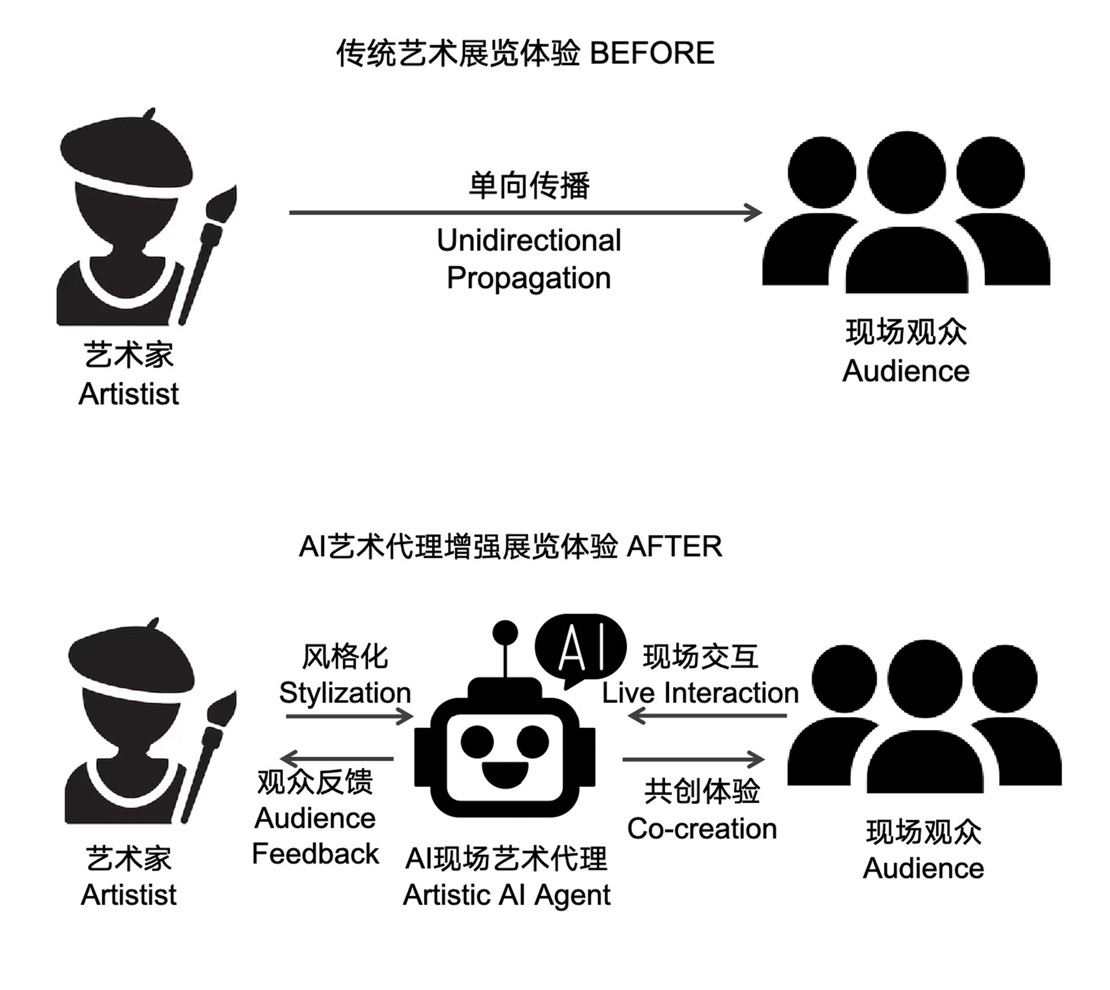
2024年,本项目获得插画艺术家陈韦伶女士的授权,在Stable Diffusion XL模型的基础上,针对她的插画艺术作品的风格特征进行了人工标记和学习,得到的LoRA微调模型能够生成极具陈韦伶个人风格的插画作品。我们进一步将其与Cardboard VR和RFID结合,并在25年1月陈韦伶女士在深圳市南头古城的个人插画艺术展上首次展出了这件基于生成式AI的沉浸式交互作品。
In 2024, this project received authorization from illustrator Ms. CHEN Weilin to use her works as training data. Building on the Stable Diffusion XL model, we manually annotated and modeled the stylistic features of her illustration practice. The resulting LoRA-finetuned model is capable of generating illustrations that strongly reflect Ms. Chen’s distinctive artistic style. We further integrated this model with Cardboard VR and RFID technologies, and in January 2025 we premiered this generative-AI-based immersive interactive artwork at Ms. Chen’s solo illustration exhibition in Nantou Ancient City, Shenzhen.
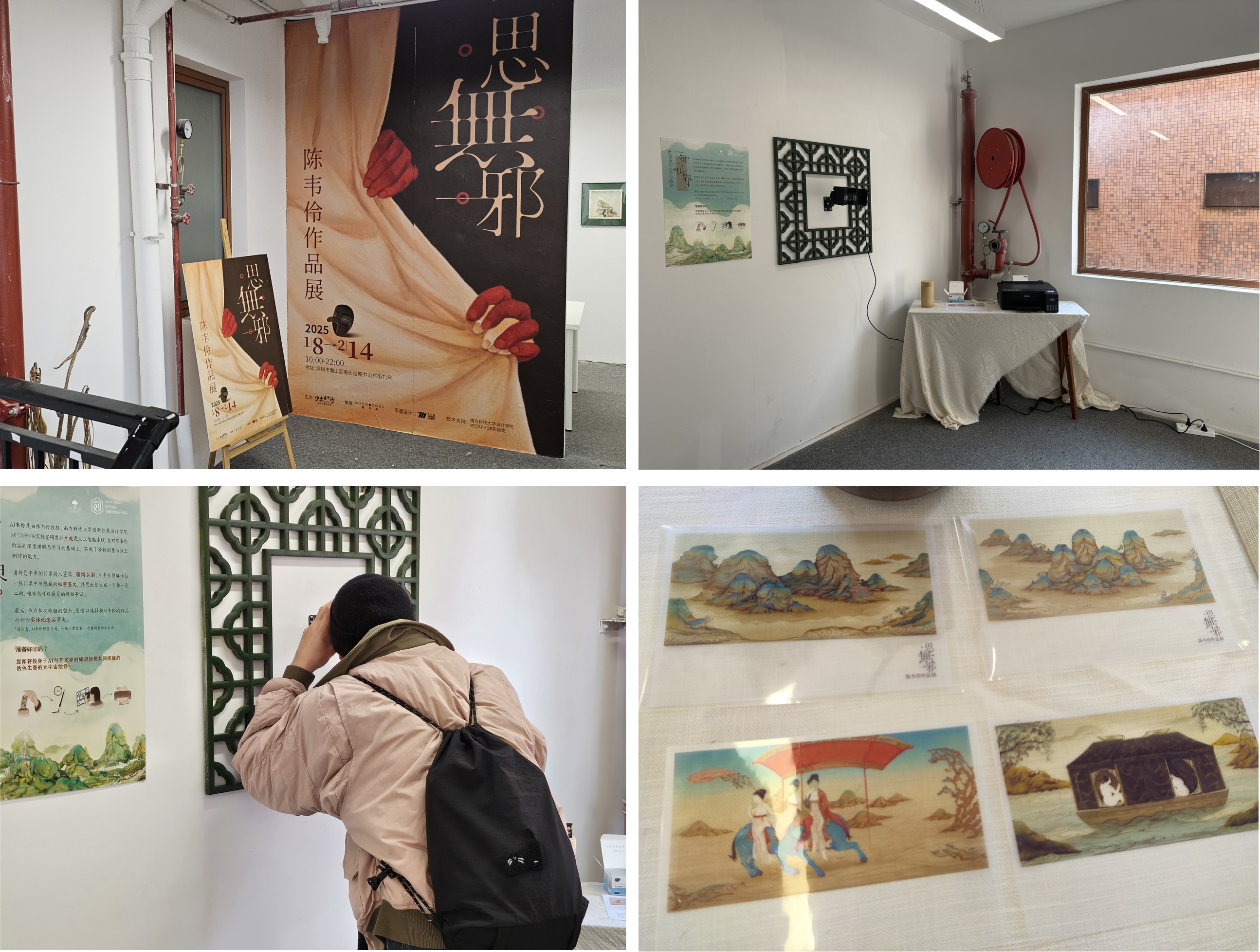
该作品受到韦伶女士的《窥》作品的灵感启发,将VR头显固定在展馆墙面的木制窗棂中央;来场观众可以通过将粘贴有RFID标签的门票,即「签文」,投入底部放置了RFID读卡器的签筒内,凑近VR头显后稍待片刻,即可观看到生成式艺术代理从「签文」内隐含的关键词解读、渲染出来的VR画作。我们准备了四类不同签面的门票供观众选择,但即便是同一类门票,每位观众在VR中观看到的依然是独一无二、独属于她/他的绘卷。 在观赏完AI韦伶的作品后,如果观众喜欢该作品,可以选择将其打印为一张实体明信片,作为观展体验的纪念品一同带走。
Inspired by Ms. Chen’s work Peeping, the piece fixes a VR headset at the center of a wooden window lattice mounted on the exhibition wall. Visitors can place their admission ticket—referred to as a “fortune slip,” each ticket carrying an RFID tag—into a cylindrical container at the bottom that houses an RFID reader. After leaning in toward the VR headset and waiting briefly, they are able to view a VR painting generated by the intelligent art agent, which interprets and renders imagery based on the keywords implicitly encoded in the “fortune slip.” We prepared four different categories of ticket designs for visitors to choose from; yet even for tickets of the same category, each visitor encounters a unique scroll in VR, one that belongs only to her or him.
After viewing the work created by “AI Weilin”, if a visitor particularly likes the generated piece, they may choose to have it printed as a physical postcard to take away as a memento of their exhibition experience.
下一代沉浸式共创体验
2025年底,本项目受到深圳市雅昌艺术中心AI艺术展策展方之邀,将原系统进一步改良展出(见首图)。我们增加了更多不同的艺术家风格、主题及视觉元素作为提示词,并以实体桌游卡牌的方式展出。现场观众可以通过自由排列、组合不同的卡牌并扫描,探索表达更丰富、可玩性以及互动性更高的现场展览共创体验。
At the end of 2025, the project was invited by the curatorial team of the AI Art Exhibition at Artron Art Center in Shenzhen to further refine and showcase the original system (see the first image). We expanded the range of prompts by incorporating more artistic styles, themes, and visual elements from different artists, and presented them in the form of physical board-game-style cards. On site, visitors can freely arrange and combine these cards and then scan them, thereby exploring a richer, more playful, and more interactive co-creative exhibition experience.