
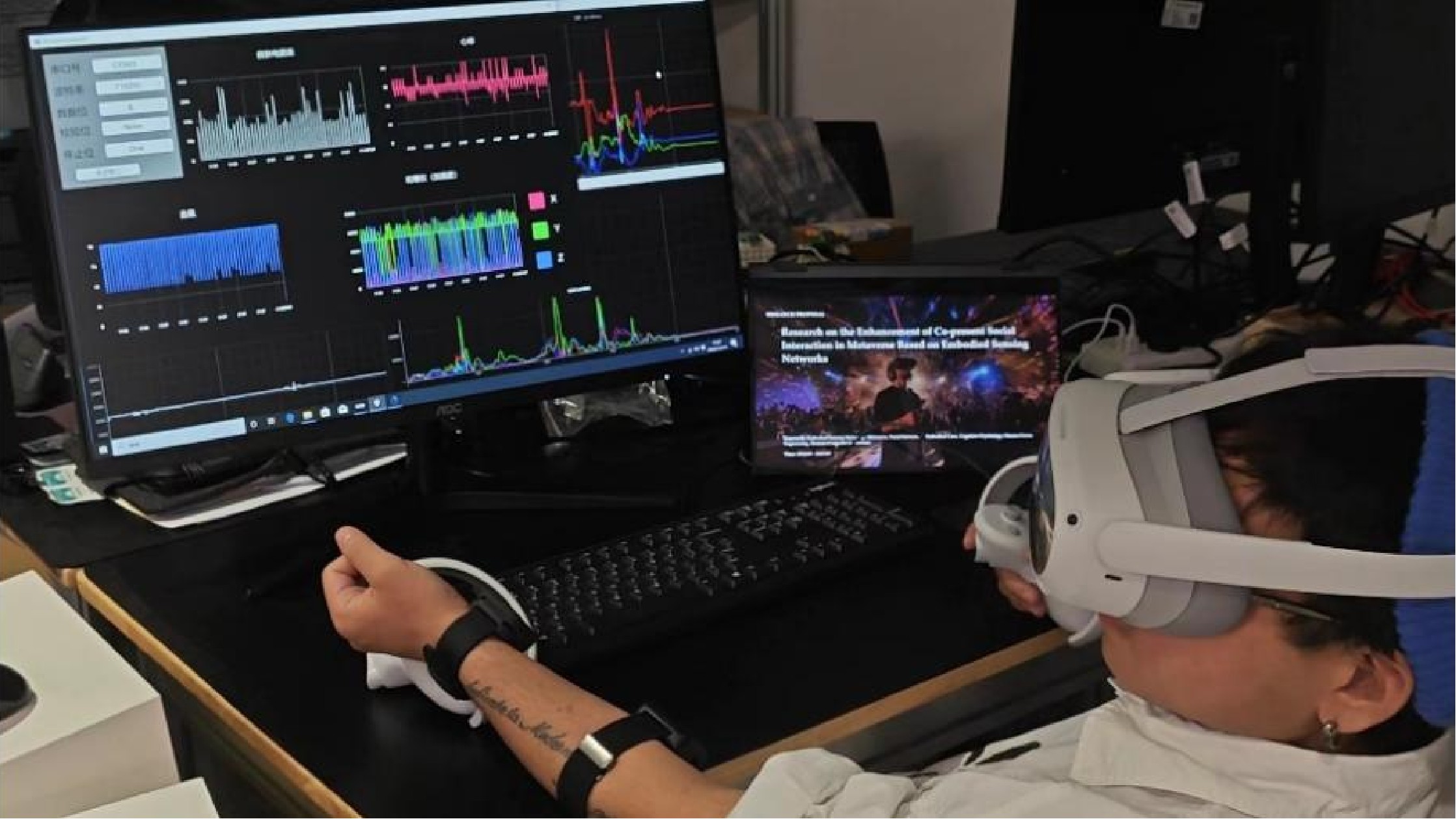
BioMetaphor: Metaverse Copresent Embodied Social Experience
BioMetpahor: 元宇宙共在式具身社交体验
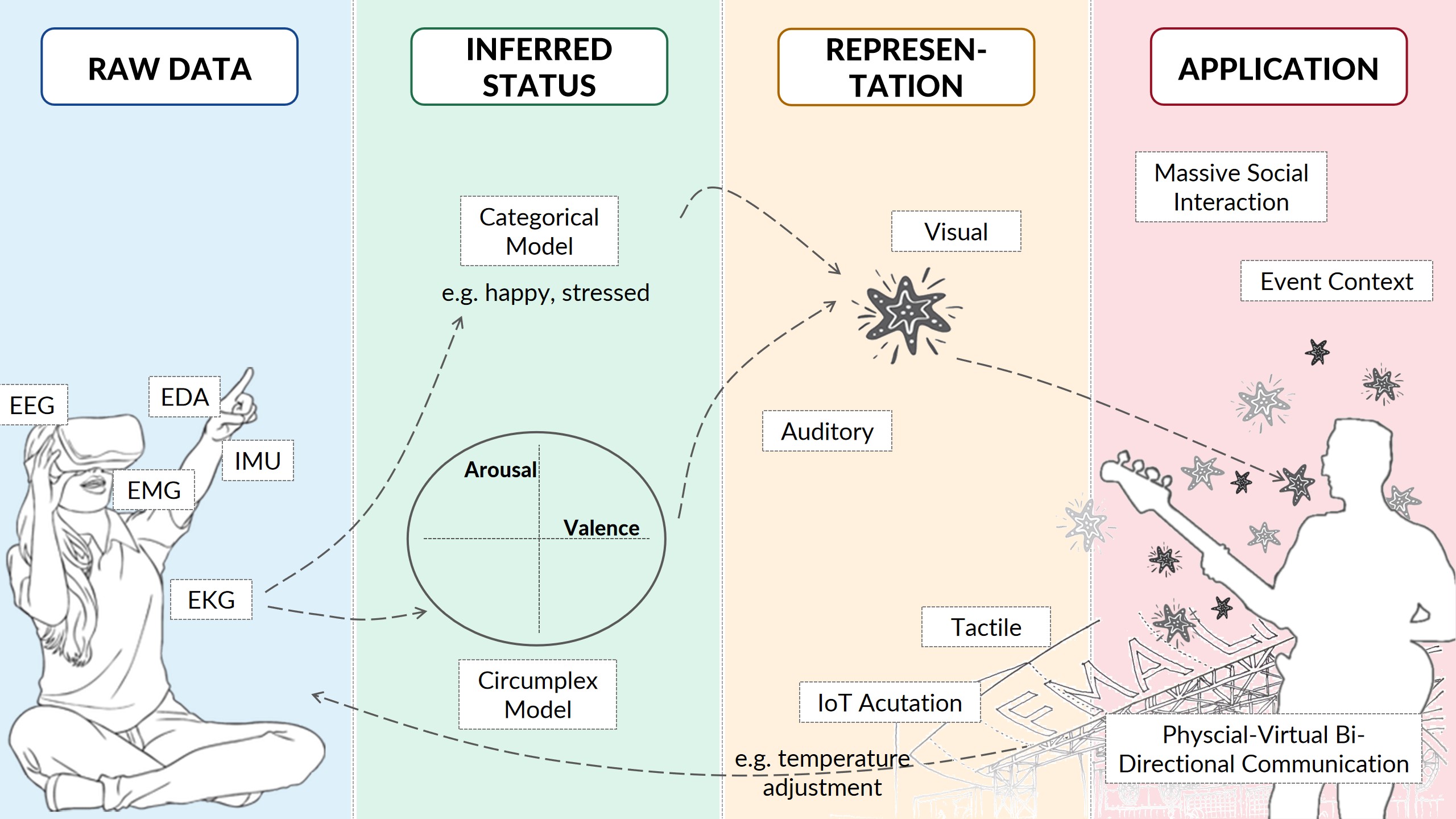
随着虚拟现实与在线社交平台的迅速发展,在完全或部分虚拟的活动中(如混合会议、VR 音乐会等),线上与线下用户可以共同在场,分享沉浸式体验。然而,这类虚拟或混合共在活动与实体活动相比,仍存在显著差距。 当前此类场景中普遍采用虚拟化身(avatar)传递信息,侧重一对一复制显性的社交线索,例如语言、面部表情和肢体动作等。但在许多大规模共在场景中,人群整体及群体状态往往才是更重要的「信息焦点」,而虚拟化身未必是天然一致且高效的表达方式。本研究尝试跳脱基于传统虚拟化身范式,转而关注隐性的社交线索,例如反映个体内在心理‑生理状态的生物感知数据。
In fully or partially virtual events, online (and offline) users can be co-present and share immersive experiences, such as hybrid conferences and VR concerts etc. This kind of virtual or hybrid co-present events, however, still exposes a significant gap when compared to its physical counterpart. Currently, avatar-mediated communication prevails in such venues, emphasizing one-to-one replication of explicit social cues, e.g. verbal language, facial expression and gestures etc. In many large-scale co-present scenes, crowd and collective status are considered as more "information of interest", where avatars may not be an innately coherent and cost-effective representation. Alternative to the avatar-based paradigm, this research aims at exploring implicit social cues instead, such as biosensory information, that reveal and reflect individuals' internal psychophysiological states.
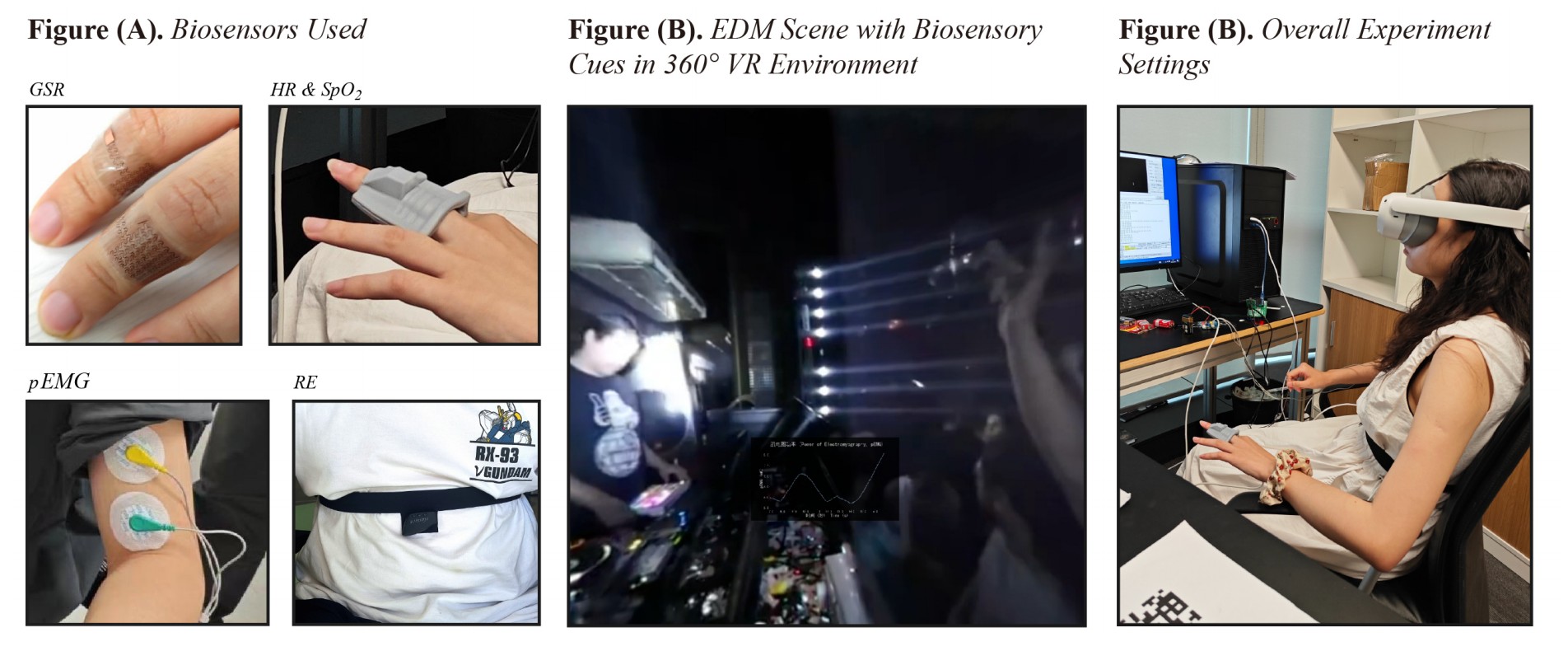
为探究哪些生理数据最能呈现个体的内在状态,以及这些数据如何影响共在体验,我们在一项虚拟现实DJ表演场景中开展了初步测试,整合了五种不同的生物信号:肌电功率(pEMG)、皮电反应(GSR)、心率(HR)、呼吸幅度(RE)以及脉搏血氧饱和度(SpO₂)。 这项包含 72 名有效参与者的非随机对照实验表明,GSR能显著增强生理同步性;同时,对10名参与者的半结构式访谈显示,RE和HR在用户主观感知中最能强化共在体验。
To investigate what kinds of biometric data can best surface people's inner states and how it consequently affects the copresent exprience, we carried out a preliminary test in a virtual reality (VR) electronic dance music setting and integrates five different bio-signals, namely power of electromyography (pEMG), galvanic skin response (GSR), heart rate (HR), respiration effort (RE), oxyhemoglobin saturation by pulse oximetry (SpO2). The non-randomized controlled experiment with 72 valid participants revealed that GSR enhanced physiological synchrony significantly and semi-structure interviews with 10 participants indicated that RE and HR provided the strongest user-perceived copresent experience.
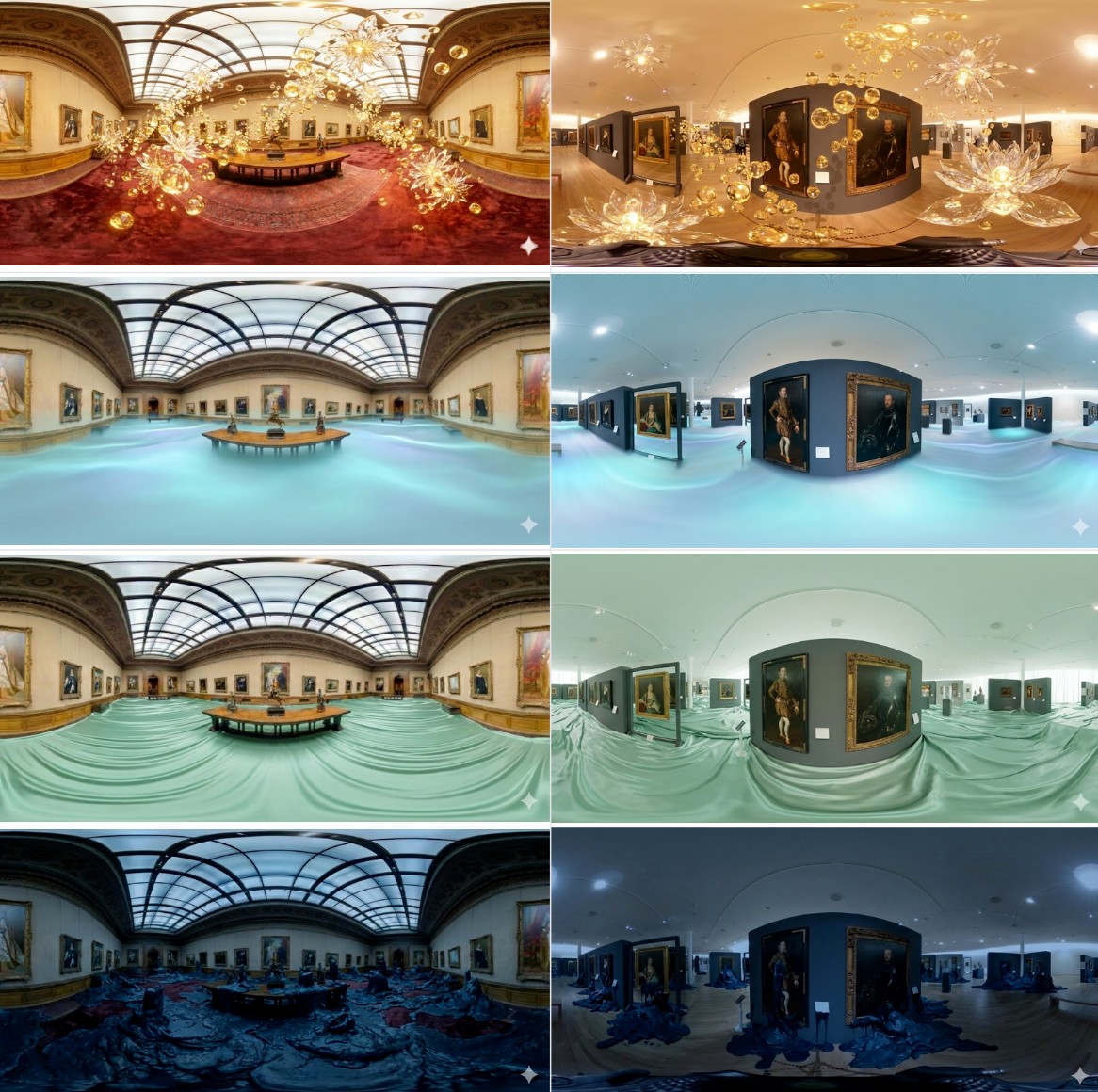
在确定了下一步要使用的生理信号之后,后续我们组织了一场有30位人机交互领域专家参与的工作坊。我们邀请各位专家针对不同的共在式场景,使用文生图工具自由发挥创意,以他们所认可的、具有吸引力的方式来表达三种生理信号。该工作坊揭示了一个有趣的现象,即相较于传统的原始生理信号可视化,大部分参与者更倾向于使用一种隐喻式的方式来呈现生理信号,这也成为了我们提出BioMetaphor这个理论框架的契机。 此前的研究告诉我们,隐喻不仅限于语言(a matter of language),更是人类构筑其复杂概念系统的基础,成为人类高阶抽象思维的一个重要特征。BioMetaphor框架在这个基础上尝试将隐喻式思维的特征通过提示词工程引入大语言模型,让生成式人工智能学会如何理解人类的内在状态、又如何将这些内在状态转译成符合人类思维特征的隐喻式表达。
After identifying which physiological signals to use in the next stage, we organized a workshop with 30 HCI experts. We invited these experts to freely explore and express three types of biodata in ways they found appealing and meaningful, using text-to-image tools to design representations tailored to different co-present scenarios. The workshop revealed an interesting phenomenon: compared with traditional visualizations of raw physiological data, most participants preferred to present these biodata in a metaphorical manner.
This became the starting point for our theoretical framework, BioMetaphor. Prior research has shown that metaphor is not merely a matter of language, but also a fundamental mechanism through which humans construct complex conceptual systems, and thus a key feature of higher-order abstract thinking. Building on this insight, BioMetaphor attempts to introduce metaphorical thinking into large language models via prompt engineering, enabling generative AI to learn how to interpret human inner states and translate them into metaphorical expressions that align with human cognitive characteristics.
该项目未来将重点关注验证BioMetaphor框架的有效性及其对共在式社交体验的具体影响,并进一步改善从具身生理传感数据到生成式人工智能的工作流,使其更符合各类共在式体验的现场需求。
This project will next focus on validating the effectiveness of the BioMetaphor framework and its impact on copresent social experiences. In addition, we aim to further refine the workflow from embodied physiological sensing to generative AI, so that it better meets the practical needs of various copresent experience settings.