

Pervasive Mixed Reality Engine
泛在式混合现实游戏引擎
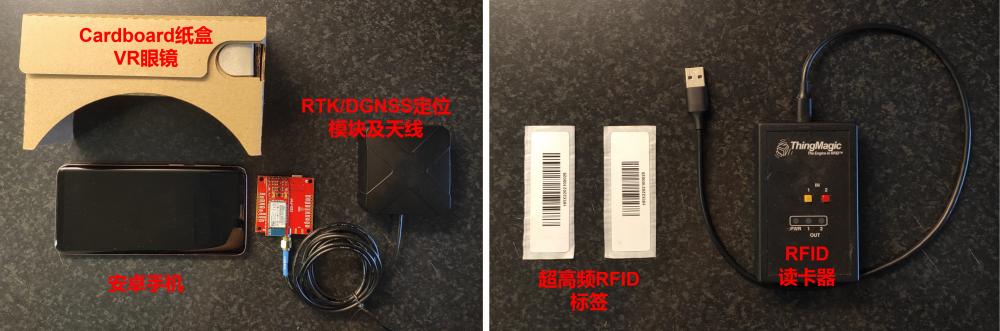
泛在式混合现实游戏引擎是用于进行泛在式混合现实(Mixed Reality, MR)游戏及游戏化应用设计与开发的模块化技术栈。泛在式游戏,指的是依托移动与泛在计算技术,将游戏过程延展到玩家的日常物理与社会环境中的一种游戏形态,使游戏体验在时间、空间与社交情境上突破传统数字游戏的边界。然而,当前的虚拟现实技术往往受限于沉重的头戴式显示设备以及有限的活动空间,无法真正将沉浸式的内容及体验扩张到日常生活之中。因此在本项目中,我们首先大胆地尝试将实时动态(Real Time Kinematic, RTK)高精度定位技术,与利用智能手机的便捷式纸盒VR(Cardboard VR)相结合,实现了可用于户外环境活动的虚拟现实技术,见下图。
The pervasive mixed reality game engine is a modular technology stack for the design and development of pervasive mixed reality (MR) games and gamified applications. Pervasive games are a form of gameplay that, building on mobile and ubiquitous computing technologies, extend the game process into players’ everyday physical and social environments, thereby pushing the boundaries of traditional digital games in terms of time, space, and social context. However, current virtual reality technologies are often constrained by bulky head-mounted displays and limited movement space, making it difficult to truly extend immersive contents and experiences into daily life. In this project, we therefore took the bold step of combining Real Time Kinematic (RTK) high-precision positioning technology with Cardboard VR, a lightweight smartphone-based VR solution, to realize a form of virtual reality suitable for outdoor activities, as shown in the figure below.

由于Cardboard VR主要用于被动观看、本身自带的交互方式有限,为了满足更多样化的游戏交互需求,我们进一步整合了无线射频识别(Radio Frequency IDentification, RFID)技术模块。具体来说,我们使用的是其中被动式超高频RFID标签和读卡器,它的技术特征是标签本身无源无线缆,成本造价低,理论上识别范围可达10至15米。在实际使用中,可以通过降低读卡器的读取功率,灵活调整标签的识别范围,因此可适用于多种互动距离、精度和可活动范围的游戏场景。
Since Cardboard VR is primarily designed for passive viewing and offers limited built-in interaction methods, we further integrated a Radio Frequency Identification (RFID) module to support more diverse forms of game interaction. Specifically, we use passive ultra-high-frequency (UHF) RFID tags and readers. Technically, these tags are power- and cable-free, low in cost, and can be recognized within a range of about 10 to 15 meters. In practical use, the read range can be flexibly adjusted by lowering the reader’s transmission power, making this technology suitable for game scenarios with varying interaction proximity, precision and activity areas.
RFID用于实体用户界面
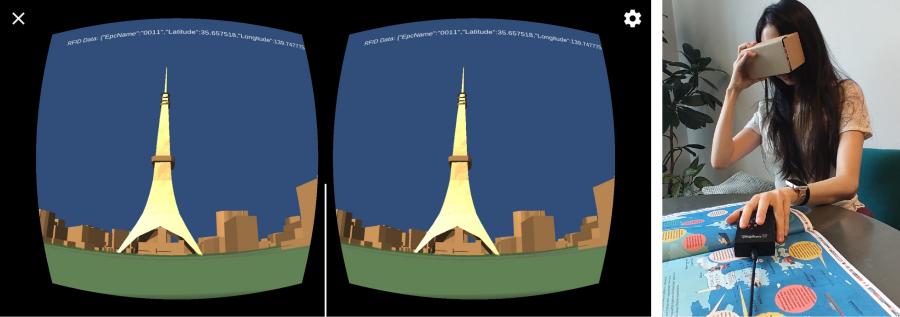
RFID带来的第一种新的技术赋能特性(Technological Affordance)是利用被动式RFID标签可以简单贴附于各类日常物品、道具、服装、建筑物等表面的特性,从而能够实现与各类物理实体的智能交互。如下图所示,用户通过手持式读卡器扫描粘贴了RFID标签的地图册,不同的标签对应地图册上不同地点的经纬度信息,当读取到特定地点的标签信息——如东京时,VR内会对应「传送(teleport)」到该地点的地标位置。 根据不同的泛在式游戏场景,开发者可以选择将标签固定于环境或物体表面,例如博物馆内的展品,而玩家使用移动手持式读卡器进行探索;或者反过来,玩家的道具或者服装上贴附标签,进入定点读卡器的读卡区域以后,触发特定的游戏事件等等。RFID的技术特性使得弹性的部署方式和多样化的应用场景成为可能。
The first new technological affordance brought by RFID lies in the fact that passive RFID tags can be easily attached to the surfaces of various everyday objects, props, clothing, buildings, and so on, thereby enabling intelligent interaction with a wide range of physical entities. As shown in the figure below, the user scans an atlas with attached RFID tags using a handheld reader. Different tags correspond to the latitude and longitude information of different locations on the map. When the tag for a specific location—such as Tokyo—is read, the VR experience will “teleport” the user to the landmark location associated with that place. Depending on the specific pervasive game scenario, developers can choose to affix tags to the environment or object surfaces—for example, museum exhibits—allowing players to explore using a mobile handheld reader; or, conversely, they can attach tags to players’ props or clothing, so that when players enter the reading area of a fixed RFID reader, certain in-game events are triggered. The technical characteristics of RFID thus make flexible deployment strategies and diverse application scenarios possible.
RFID用于体感运动触发
通过调整读取范围和肢体运动距离,RFID同样也可以成为体感游戏的控制入口。如下图所示,玩家的左右肘部以及左膝处分别贴了三张RFID标签,当玩家做出抬肘或抬膝的动作时,对应的标签进入读卡器的读卡范围,从而触发对应的控制命令:左肘对应控制游戏角色向左移动,右肘对应向右移动,而抬左膝对应跳跃。
尽管该示例仅仅利用了一个简单的键位映射,但同样的方法可以适用于将大部分按键控制的游戏转化为使用身体动作控制的体感游戏。由于RFID标签只提供激活与否两种状态(即扫描得到或扫描不到),因此作为简单的双向动作开关(binary trigger),可能无法提供精细颗粒度的实时动态轨迹追踪;但对于需要广泛探索的游戏初期设计阶段,RFID能使创作者无需去关注实现动作捕捉技术底层细节,便能够快速模拟、趋近、测试各种体感交互体验的场景。
By adjusting the read range and the distance of bodily movements, RFID can also serve as an input channel for motion-based games. As shown in the figure below, three RFID tags are attached to the player’s left and right elbows and left knee. When the player raises an elbow or lifts the knee, the corresponding tag enters the reader’s detection range, thereby triggering the associated control command: raising the left elbow moves the game character to the left, raising the right elbow moves it to the right, and lifting the left knee triggers a jump.
Although this example uses only a simple key-mapping scheme, the same approach can be applied to convert most button-controlled games into motion-controlled games. Since RFID tags only provide two states—either activated or not (i.e., read or not read)—they function as simple binary triggers and may be unable to support fine-grained, real-time dynamic trajectory tracking. However, in the early stages of game design where broad exploration is needed, RFID enables creators to quickly simulate, approximate, and test various motion-based interaction scenarios without having to deal with the underlying technical details of motion capture.

RFID用于动态资产加载
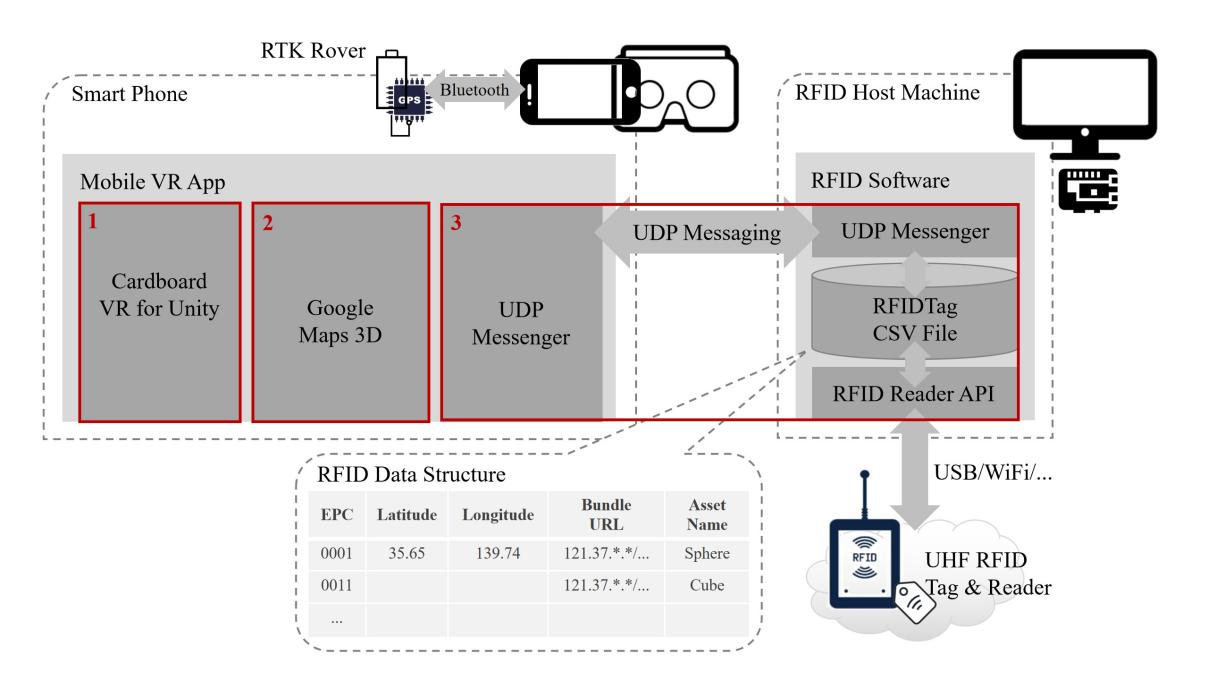
RFID的最后一种,也是最频繁广泛被使用的技术赋能特性是用于游戏或应用内的动态资产加载。该特性结合了目前游戏引擎的动态资产捆包加载(Dynamic Asset Bunddle Loading)方法,在扫描到特定RFID标签时,动态地从标签所指定的远端服务器通过http协议拉取资产捆包,并把指定的资产实时渲染、加载至VR环境中。
该方法的优点是无需改动VR应用端的代码,也无需事先在应用内渲染、打包预制件,而仅需通过RFID标签指定对应的资产服务器URL地址,从而便于玩家上传用户创作内容(User generated contents)到VR环境中,并且对于加载资产内容的格式与种类没有特定限制。缺点是针对较大型的资产,例如高清4K视频文件等,下载及加载所耗费的时长往往取决于用户的网络速度和状况。
The final—and also the most frequently and widely used—technological affordance of RFID lies in its use for dynamic asset loading within games or applications. This affordance is combined with the dynamic asset bundle loading mechanisms of modern game engines: when a specific RFID tag is scanned, the system dynamically pulls the corresponding asset bundle from a remote server designated by the tag via the HTTP protocol, and then renders and loads the specified assets into the VR environment in real time.
The advantage of this approach is that it requires no modification to the VR application’s client-side code, nor any need to pre-render or pre-package prefabs within the application. Instead, it is sufficient to have each RFID tag specify the URL of the corresponding asset server, which facilitates players in uploading user-generated content (UGC) into the VR environment and imposes no strict limitations on the formats or types of assets to be loaded. The downside is that for larger assets—such as high-definition 4K video files—the time required for downloading and loading often depends heavily on the user’s network speed and conditions.
总结
本项目提出的泛在式混合现实游戏引擎,采用了高度模块化的系统设计以及全商业现货级别的硬件设备,确保了该架构的低成本、高可扩张性、高复用性,使其同时适用于户内/户外的各类游戏场景。
The pervasive mixed reality game engine proposed in this project adopts a highly modular system design and relies entirely on commercially available off‑the‑shelf hardware devices. This ensures a low-cost, highly scalable, and highly reusable architecture that can be applied to a wide range of both indoor and outdoor game scenarios.